

Multipliers
How to make everyone smarter

“Multipliers are “genius makers” who amplify their team’s intelligence, whereas Diminishers drain capability and underutilize talent, getting less than half of the team’s potential output.”

Welcome to “Students of Leadership,” today with a newsletter based on a book I love for its concepts, for the well researched evidence and for the alternative that presents us with… If something I never wanted to be in my life, on purpose or inadvertently, directly or indirectly, is to diminish people’s potential.
Multipliers
Are you a genius or a genius-maker? In every organization, there are leaders who multiply the intelligence and capability of their people, and those who diminish it.
In the book Multipliers, author Liz Wiseman documents how the best leaders make everyone smarter. Her research found that typical managers tap only about 66% of their team’s capability, while true Multipliers get 2× more from their people. No leader can afford to leave that much talent “on the table.”
Key Messages from “Multipliers”
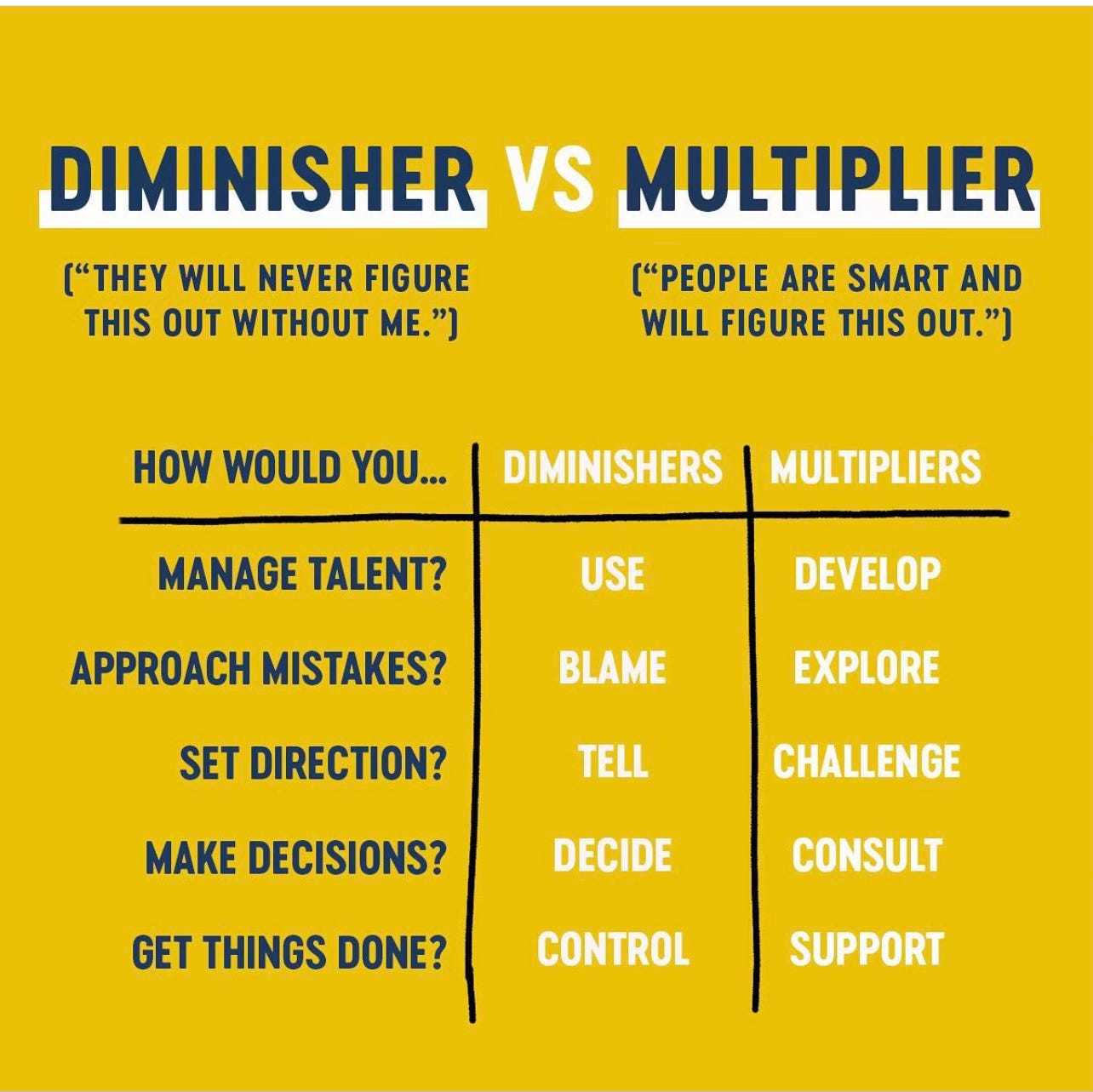
At its core, Multipliers delivers a simple but profound message: Leaders who invest in others’ genius get far greater results. The author defines a Multiplier as a leader who uses their intelligence to amplify the smarts and capabilities of those around them, making everyone better and more capable, they are what she calls “genius makers.” In contrast, Diminishers are leaders who may be highly intelligent personally but stifle the talent around them, they drain others’ energy and ideas by needing to always be the smartest person in the room, hence getting only a fraction of their team’s true potential, and in many or most cases frustrating and uninspiring people along the way.
The best thing to do then is to look at the mirror and ask ourselves “Which type of leader are you?” Take a hard look at your team’s behavior and results. People working with Multipliers feel smart and motivated, they give 110% effort, stretch beyond their comfort zones, and “hold nothing back.” Under a Multiplier, team members often exceed their previous capacity and continue growing. By contrast, people under a Diminisher often shut down because of fear or because of a deep feeling or being just like a cog in a wheel, holding back ideas, feeling undervalued or leaving the team altogether. Is your leadership approach accidentally limiting your team?
Some of the unintentional behaviors that can diminish your team’s potential are: 1. You are the “Idea Fountain” which can inadvertently kill the creativity of others, 2. You are the “Rapid Responder” who jumps in with answers to everything or the with the smartest solution at the slightest sign of trouble, which can prevent people from learning and solving problems themselves.
Most likely we all have diminishing behaviors to unlearn, so the first insight is that multiplier leadership starts with a mindset shift to learn new behaviors. Support your people by showing them you believe they are smart and will figure things out. Set very high expectations and a rigorous pace, at the end we need high performance, but make sure you engage, there is no need for fear and intimidation. Create a safe environment, welcome debate and demand your team’s best thinking.
“Multipliers don’t belittle their employees, but they don’t coddle them either. They let people make mistakes, but they expect people to learn from them. They create an environment that is intense (demanding), but not tense (stressful)”.
Under a Multiplier’s leadership, the blend of support and high challenge is what unlocks exponential performance.
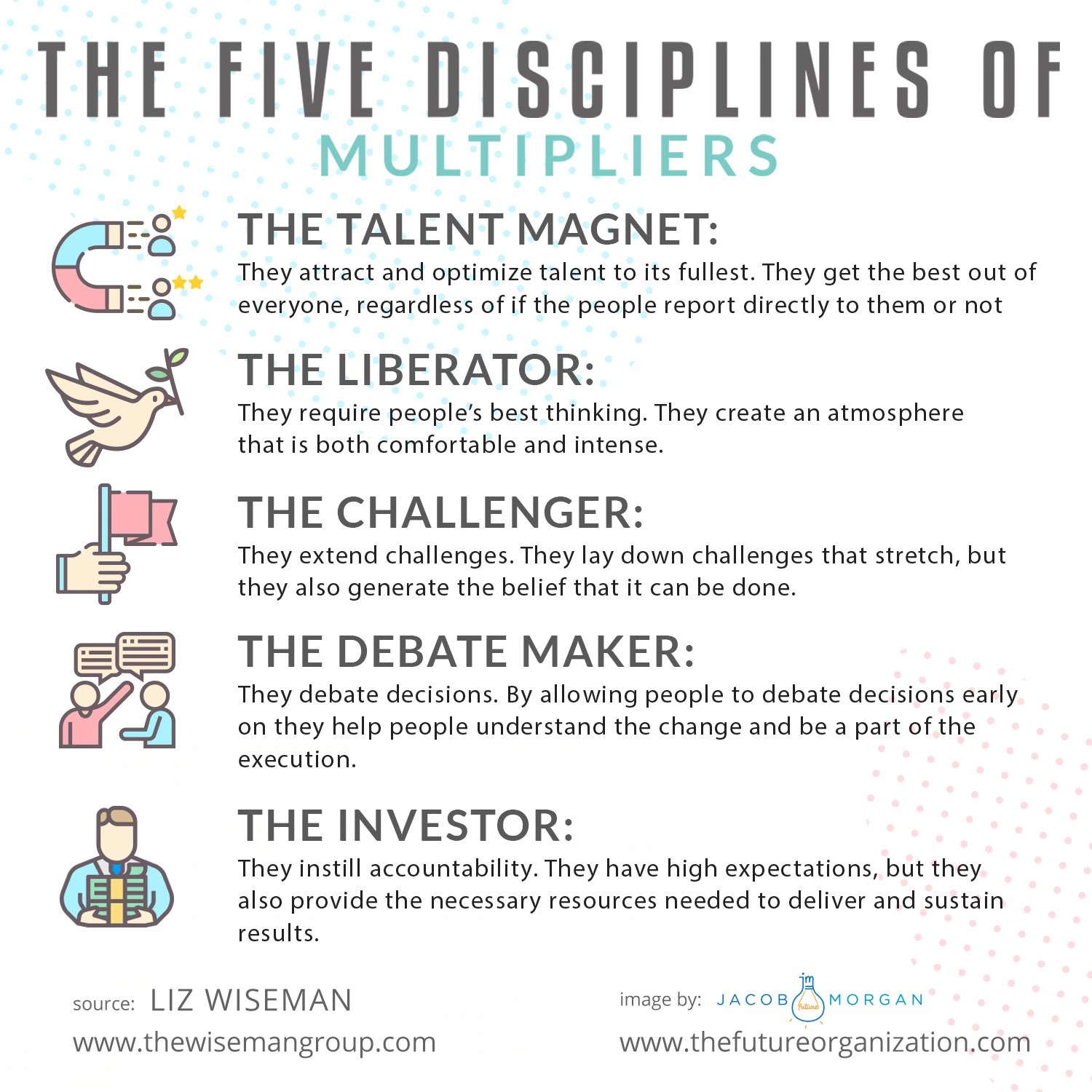
The Multiplier Leadership Framework Includes 5 Key Disciplines
These are the five areas in which you can consciously change your habits to get the most from your team.
Talent Magnet
Attract and Optimize Talent: Multipliers draw talented people to them and fully utilize the capabilities of each person. This last part is a very important one because it is not enough to attract the best talent if then you will put them under ways of working that do not let them tap into their strengths, be at their best. The opposite is to be an Empire Builder, where you are good at hoarding talent to then keeping people in narrow roles. A Talent Magnet actively scouts for diverse skills, encourages growth, and let their superstar employees move on to bigger opportunities when it’s time. To practice this, try “naming the genius” of each person on your team, identify the unique talent or passion they bring, and look for ways to redesign roles or delegate responsibilities to leverage those talents.
Liberator
Create Intense, Safe Environments: A Multiplier acts as a Liberator, creating an atmosphere of trust, safety, and intense focus so that people can do their best thinking. A “tyrannical” Diminisher will instill anxiety and shut people down. Being a Liberator means demanding excellence, to be clear, you don’t lower the bar, you raise it, but what you do is to remove the fear from the room. Encourage debate, modeling respectful dissent, listen more than you talk, and respond to mistakes with curiosity and coaching rather than punishment. Give people permission to think out loud without repercussions. As Wiseman writes, “Multipliers liberate people to think, to speak, and to act... They give people permission to think.” and I add, “to think freely not to feel forced to give you their best curated thought otherwise…” When people feel both safe and challenged, they will show your how resourceful they are.
Challenger
Extend Compelling Challenges: Multipliers are Challengers who define opportunities that stretch the team to new heights. Instead of playing the Know-It-All who always has the right answer (a common “diminisher" behavior), a Multiplier challenges by asking and framing, asking again and reframing. They set a bold vision and pose challenging problems inviting their team to co-crate and collaborate to solve them because they believe their people are smart enough to find the answers: “invite people to stretch beyond what they currently know how to do.” Identify a “Mission Impossible” or what others call “Moonshot” style goal that’s just beyond your team’s current reach, and challenge them to achieve it without mapping out the whole plan for them. Your job as a Challenger is to sell the stretch vision and then step back and let your team figure out how to make it reality. “Good leaders don’t just give people more work, they give them harder work, a bigger challenge that prompts deep learning and growth.”
Debate Maker
Drive Sound Decisions through Debate: Rather than being the one who dictates choices, a Multiplier is a Debate Maker by engaging the team in rigorous, inclusive debate before important decisions are made. They leverage collective intelligence asking the tough questions and letting others weigh in. They maximize input up front so that once a decision is reached, everyone understands the reasoning and is committed to the outcome. This is an important distinction from thinking that every decision is by consensus, it is not the case. In practice, acting as a Debate Maker might mean calling for a meeting to destroy a proposed a strategy where you facilitate the discussion to ensure the best ideas surface through healthy conflict. Boldly scrutinize ideas, not people. The Diminisher acts as a unilateral decision maker, the Multiplier operates as a Debate Maker.” When the team has a voice in the rationale for making a decision, their buy-in and understanding is sound and their engagement and ownership will multiply.
Investor
Instill Ownership and Accountability: The Investor is a leader who trusts the team to deliver, that gives ownership for the outcome and delegates responsibility to empower people by giving them the resources and support they need. The Diminisher is by default a Micromanager, jumping in and out of their team’s work, destroying autonomy. In practice, becoming an Investor means deliberately doing less, but expecting more. You start acting as a sounding board to elevate and coach a lot more than you control and dictate, but don’t forget to “give the pen back,” meaning that if you step in to guide or teach, always return the pen so your people continue to shape the narrative and write the story. When you entrust someone with a mission people must rise to that trust, and the whole team’s capacity grows. An Investor Multiplier seeks to compound impact by ultimately building other leaders.
From Insight to Action – Become a Multiplier
The difference between a good team and a great team often comes down to leadership, and in any leadership context, from CEO to project leader, the job is to make the team excel, not to act as the lone genius with a grout that take orders.
Becoming a Multipliers is a call to action for leadership to step out and put the team on the stage. Performance explodes when you shift from being the hero to being the hero-maker, and this is not a “nice to have” but a competitive advantage. Your team will yield more engagement and with it more innovation and more resilience. The Multiplier makes the team feel challenged, raises the bar high, and also makes them feel trusted, safe and empowered.
As I always like to point out, look in the mirror, without self-awareness there’s little left, and think when are you being an accidental diminisher, what multiplier disciplines can you put in practice? How? When? To see what change?
“Multipliers get more from their people because they are leaders who look beyond their own genius and focus their energy on extracting and extending the genius of others.
Bold, pragmatic and impact oriented leadership is about multiplication, not subtraction. Choose to be the kind of leader who multiplies talent. Believe that the people around you are capable of incredible things if you lead in a way that makes them smarter. Put the pressure on you!
P.S. Before I go, here you have “The Treat,” where I share some of the music that kept me company while writing …
Today no music again, but a 4 minutes video from the author herself on the difference between Multiplier and Diminishing Leadership. It’s worth the listen.
“Lead yourself, Learn to live. Lead others, Learn to Build.”
If you enjoyed reading this post consider subscribing to the newsletter for free, joining the community and sharing your thoughts.
Thanks for this newsletter. Inspiring and informative.