

Knowledge without Wisdom
will wisdom die on the sword of instant hyper-knowledge?

“Where is the wisdom we have lost in knowledge?”
T.S. Eliot
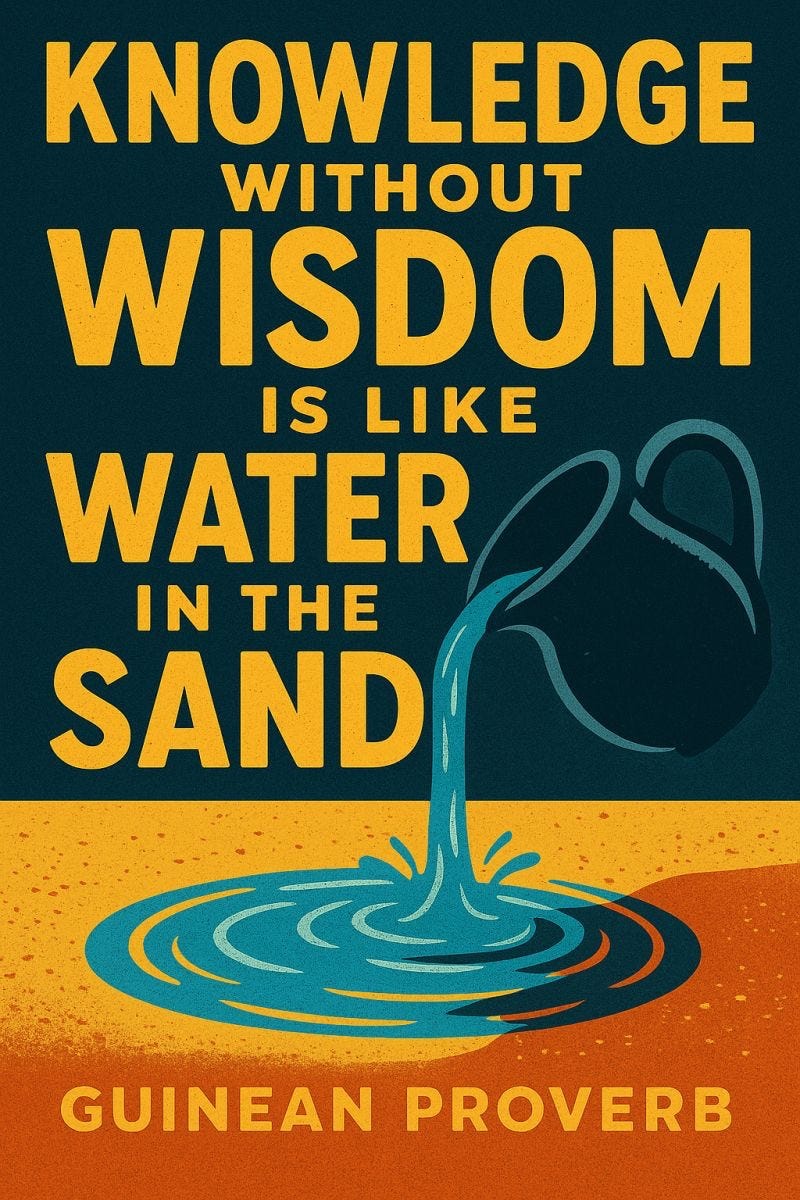
We are the most informed generation that has ever lived, however we may also be among the least wise. I know it’s a provocative statement, and I don’t know if it factual, but certainly feels like it.
However, in leadership, that gap is not merely philosophical curiosity, it is the quiet distance between the ability to build on solid grounds, and catastrophe.
Sometime in the last fifteen years, without ceremony and without anyone signing anything contract of agreement, practically every human being on earth was handed the keys to the greatest library that has ever existed. Let alone the exponential acceleration over the past three years. The entire accumulated record of our species, every treatise, every study, every argument, every counter-argument, every new idea, folded into a piece of hardware that fits in a pocket and answers in seconds.
It should have made us wise.
But it did something dangerous.
It made us certain.
Sit at any dinner table and watch how quickly a complex subject — monetary policy, a clinical trial, the root causes of a war, the architecture of someone else’s marriage, is settled with total confidence by a person who has never built depth of knowledge and complexity in understanding about the topic.
We have never had more access to truth and never been more lazy to do the humbling work of actually earning an understanding of it.
This is the paradox I want to share today… We have greatly solved the problem of access, but we have not helped solve the problem of judgment. And the gap between the two, between knowing things and knowing what to do with them, is one of the most dangerous gap in the human story. The ancients called it wisdom, and I am worried that we are running low on it.
“Unskilled and Unaware of It”
Kruger, J. & Dunning, D. (1999)

Here is a way to see the whole thing at once.
For most of human history, navigating the open ocean was a craft, the instruments, the charts, the sextant, the chronometer, the hard-won knowledge of currents and stars, mastered by a small number of masters who had spent their lives at sea, and to cross an ocean, you needed one of them.
Knowledge was scarce, and the people who held it were precious.
Now imagine that overnight, every sailor on every ship is handed a perfect digital bridge: live satellite charts, radar, real-time weather models, the position of every vessel for a thousand miles. The instruments have been democratized, and everyone has the whole bridge in their hand.
But to your surprise we realize that this does not produce a fleet of captains. Because a chart is not a captain. The instruments can tell you where the rocks are, but they cannot tell you whether to take the narrow passage in a rising wind to make port before a dying fellow sailor fades, or to play it safe and lose the man. The instruments can show you the storm, but they cannot feel it coming in the pressure behind your eyes three hours before the barometer moves.
They can lay the whole sea before you, but they cannot tell you which voyage is worth making at all.
That gap between the instruments and the captain, between the chart and the judgment of the master, is the gap between knowledge and wisdom.
Have we just handed the whole world the instruments in the hope that we will mass-produce captains?
Nearly a century ago, watching the first electric tide of the information age, T.S. Eliot asked the question that has only grown sharper since: “Where is the wisdom we have lost in knowledge?”
He wrote that in 1934. He had no idea.
What wisdom actually is (and why you can’t download it)
We throw the word “wisdom” around as if it were a vague niceness, like the quality of grandparents or the content of fortune cookies; but the most precise account we have is more than two thousand years old, and it remains unbeaten.
In the sixth book of the Nicomachean Ethics, Aristotle does something almost no one does anymore: he refuses to treat all knowing as the same thing and pulls it apart into distinct kinds.
Episteme
scientific knowledge, the grasp of universal truths that hold always and everywhere. The boiling point of water, the structure of an antibody, the fact that interest compounds. This is what a textbook holds.
Techne
craft, the know-how to make something, like the skill to build the ship, run the assay, model the cash flow, write code. This is what a manual holds.
Phronesis
and this is the one that is slowly dissapearing. Phronesis is practical wisdom: the capacity to think deeply and deliberate well about what to do, in a particular situation, with a particular individual or group of people, under this particular uncertainty… toward an end that is genuinely good.
Practice wisdom is not about the right answer in general; it’s about the right action here and now.
Aristotle says something about phronesis that should stop every one of us cold in the age of the instant answer. He observes that the young can become accomplished in mathematics and geometry, mastering episteme and techne while still very young, but they do not become practically wise. Why? Because practical wisdom is concerned with particulars, and particulars become known only through experience. And experience takes the one thing that cannot be accelerated, compressed, summarized, or searched.
Experience takes time.
Knowledge can be transferred, acquired, accelerated.. Wisdom can only be grown, because wisdom is not a quantity of information sitting in a mind, it is a quality of judgment that forms slowly.
Aristotle has a word for it, HEXIS, which represents a settled disposition, a state of character, or ingrained way of being; built by repeated action until it becomes who you are, not what you know.
You do not know courage; you become courageous by doing courageous things until the doing is no longer a struggle. You do not know wisdom; you become wise by judging, and erring, and reflecting on the error, and judging again, ten thousand times, until discernment becomes a reflex rather than a calculation.
And when you put it all together it becomes obvious why the Google search bar or the ChatGPT prompt box cannot give it to you. They do the unthinkable time ago, they collapse time. At best they accelerate the acquisition of knowledge, but wisdom needs the time.
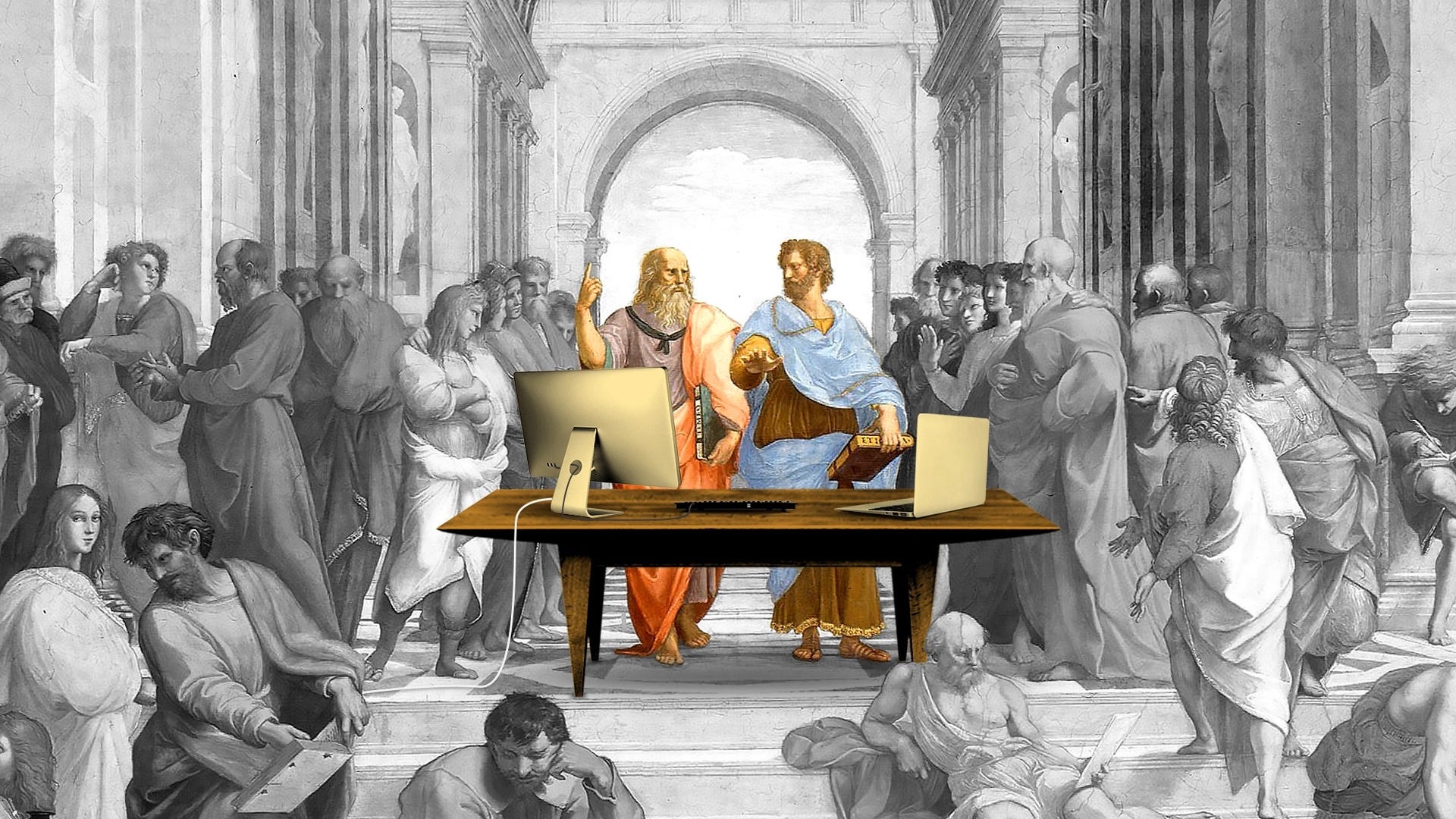
The invitation: wisdom is a craft, not a possession
If that is what wisdom is, then here is the genuinely hopeful news buried inside the diagnosis: wisdom is available to anyone willing to do the slow work.
Wisdom is not a gift of IQ, it’s not reserved for the brilliant, for the ones with the highest book count. Some of the wisest people you will ever meet are not the cleverest people in any room, and some of the smartest most educated people are catastrophically unwise.
Wisdom is a practice, and a practice is open to whoever shows up for it.
What does the practice look like?
It looks like metabolizing experience instead of merely accumulating it.
The captain is not made by sailing for thirty years alone. He is made by sailing for thirty years and thinking and reflecting about each voyage, what he read right, what he read wrong, where his confidence ran ahead of his competence. Experience without reflection is just repetition; it can make you stubborn rather than wise. The reflective loop is where actually wisdom starts to form.
It looks like seeking the friction of being wrong.
The fastest way to grow judgment is to put it where reality can correct it, to make decisions that have consequences, to invite the feedback that stings, to keep the company of people who will tell you the truth rather than the people who will tell you you’re right. Comfort is a sworn enemy of wisdom.
It looks like sitting with complexity instead of fleeing to a verdict.
The wise person has trained themselves to tolerate the discomfort of not yet knowing, to hold the question open long enough for its real shape to appear. The unwise person reaches for certainty the way a frightened hand reaches for a railing. Certainty feels like strength, but it is often just fear wearing fake clothes.
And it looks like apprenticeship
Putting yourself near people who have the judgment you lack and watching how they decide, not just what they conclude. Every tradition that has ever taken wisdom seriously, from the Stoics to the samurai to the great religious lineages, has understood that wisdom is transmitted person to person, in the presence of a life, far more than book to mind.
The bad news is that none of this is fast, and the great news is that all of it is possible.
The mirror: is this me?
Nothing worth to mistake a strong opinion for an earned one.
Have you ever delivered a confident verdict on something you understood far less well than your tone implied? Have you ever mistaken the feeling of competence (fluent, fast, articulate) for the real thing? Have you ever read three frameworks on a subject and walked away believing you had wisdom about it, when what you actually had was vocabulary?
There is a well-documented cruelty in human psychology here, named for the researchers Dunning and Kruger, who showed something the ancients already suspected: the people least equipped to judge a domain are often the most confident in their judgments of it, precisely because the same lack of skill that produces the bad judgment also robs them of the ability to see that it’s bad.
I wrote a post about this some time ago, in case you want to go back to it, here the link
Incompetence is not just a gap in ability, but a gap in the ability to perceive the gap. The less you know, the more certain you are permitted to feel.
What happens to a leader who never becomes wise
Strip leadership down to its base, past the org charts and the strategy decks, and ask what it actually is. What is the irreducible core, the thing that remains when you remove everything that could be removed?
Leadership is the exercise of judgment under uncertainty to make decisions.
That is the whole job, not having information because everyone has information now, and not even having knowledge since knowledge is readily available and getting faster, better and cheaper to get.
The job is to decide well when the answer is not in the book, when the data points in three directions, when every option costs something, and when the people you serve will live inside the consequences of your choice. Which means a leader without wisdom is not a leader with a minor deficiency, it’s a liability.
So let’s now picture that leader by inverting the whole question, instead of asking what wisdom looks like, ask what its absence looks like in a position of power.
The leader who never developed wisdom is rarely stupid or looks incompetent, and that’s what makes the failure so hard to see coming. They are usually informed and often impressively so. They can cite the study, quote the framework, recall the precedent. They are frequently decisive, because decisiveness without discernment is easy and feels like strength. They move fast. They sound right. They have an answer for everything, which is itself the tell, because the wise have learned that the truest answer is often “it depends, and here is what it depends on.”
Now put them in the storm, the genuine crisis, the situation no framework anticipated, and watch what happens. They reach for the instruments, and the instruments don’t cover this. They reach for the precedent, and there isn’t one. And because they never built the deeper faculty, because they confused having the charts with being a captain, they do the most dangerous thing a leader can do: they act with full confidence in exactly the moment they should be acting with full humility. They mistake the strength of their feeling for the soundness of their judgment.
That is the first-order consequence: a bad decision, made confidently, at the worst possible time.
But it does not stop there, and this is what makes the absence of wisdom in a leader categorically more dangerous than its absence in anyone else. Because leaders are watched, and leaders are copied. The second-order consequence is that the organization learns from the leader’s example, and what it learns is that confidence is rewarded over discernment, that speed beats depth, that having a strong opinion matters more than having earned one. The people around an unwise leader do not stay neutral, they adapt. The thoughtful ones may grow quiet or leave, but the confidence mimics rise, and the culture slowly recalibrates around the leader’s blind spots, until the whole system shares them.
And then the third-order consequence, the one that should frighten us most: an organization, or an institution, or a society that has selected for confidence over wisdom for long enough loses the very capacity to correct itself. It can no longer tell the difference between a wise voice and a merely certain one, because it has spent years promoting the certain ones and silencing the wise ones. The part of any healthy system that says “wait, are we sure?”, has been dismantled, and the group becomes magnificently informed yet structurally incapable of changing course. It accumulates more data than any generation before, but steers the boat with great confidence and excellent dashboards, directly into the rocks.
You know that final trap is? That a civilization with infinite access to knowledge and a collapsing supply of wisdom does not feel its own decline. It feels, right up until the moment it crashes, more capable than ever.
We are the most informed generation in the history of our species, with the most access to knowledge ever. We have all the instruments in a pocket size computer.
The most important question we can ask is then the older, harder, lonelier question. The one no machine will ever answer for us. The one Eliot asked in 1934 and we still have not faced:
Where is the wisdom?
Build it now. Quietly, slowly, before you need it. Because the day you need it is the day it is already too late to begin, and you will not even feel the lack until the rocks.
P.S. Before I go, here you have “The Treat,” where I share some of the music that kept me company while writing … Enjoy as you bid farewell to this post
“Lead yourself, Learn to live. Lead others, Learn to Build.”
If you enjoyed reading this post consider subscribing to the newsletter for free, joining the community and sharing your thoughts