

Don't Learn More, Learn Deeper
What a 17th-Century Swordsman Can Teach Us About Leadership Excellence

“From One Thing, Know Ten Thousand Things.”
Miyamoto Musashi
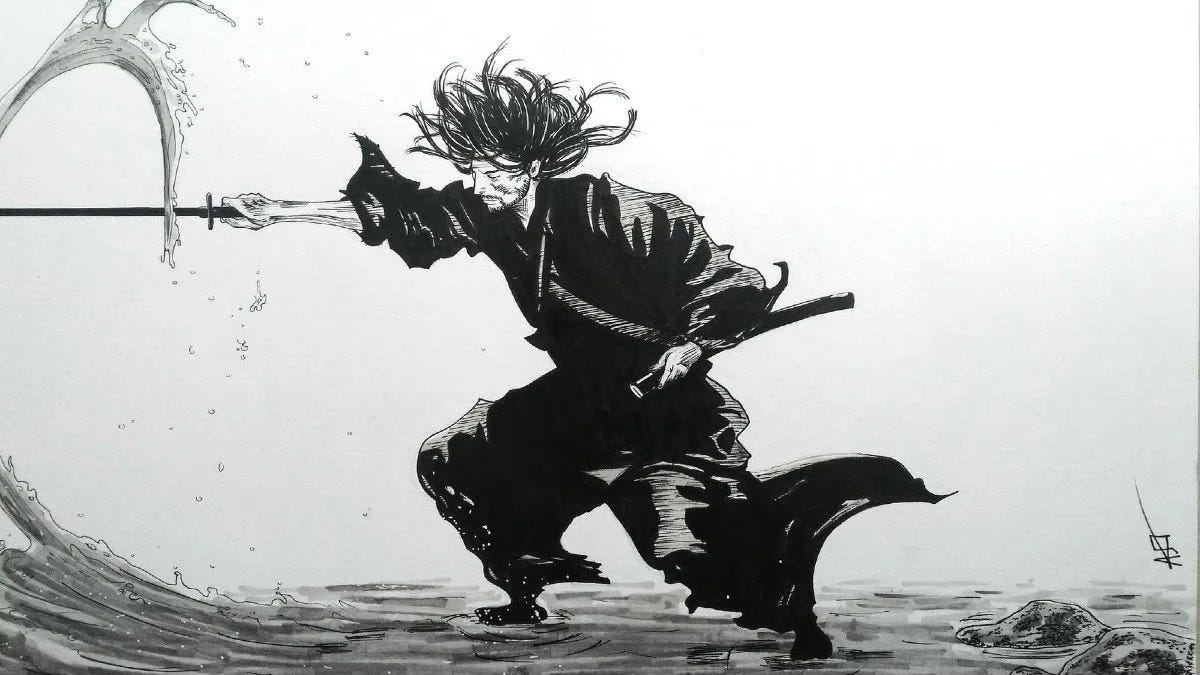
Welcome to Students of Leadership, today trying to answer this question… what dying alone in a cave taught the greatest strategist in history about seeing everything?
On the morning of April 13, 1612, a man stood alone on a sliver of sand in the Kanmon Strait…
His name was Sasaki Kojiro, considered the finest swordsman in western Japan. He had arrived on time, immaculately groomed, with his legendary long sword, nicknamed “The Drying Pole.” Everything about him communicated mastery.
His opponent, Miyamoto Musashi, arrived three hours late, in no hurry, carrying not a forged steel katana, but a wooden sword he had carved from a boat oar that morning.
Sasaki Kojiro was so furious that he drew the sword and throw the blade sheath into the sea. Musashi smiled and said “If you have no more use for your sheath, you are already dead.” The duel sadly only lasted seconds because when Kojiro attacked in anger, Musashi struck only once, and Kojiro fell dead.
Here is what most people miss about this story: Musashi did not win because he was faster, stronger, or better armed. He won because he understood something about Kojiro that Kojiro did not understand about himself, that the late arrival was not arrogance and the wooden sword was not overconfidence… It was all part of a strategy to dismantle Kojiro’s pride and composure. Every detail including the timing, the type of weapon, the words said, was carefully designed to create in Kojiro an emotional reaction to condition him, to make him lose before a single sword was raised.
How is that Musashi had such level of confidence, of mastery?
It’s because Musashi had studied one thing so deeply that he could see into the architecture of human behavior as if he had a third eye. Musashi had studied all about Combat, not just how to fight, but how people break.
Thirty years later, before dying, Musashi retreated to a cave and wrote the book that would make his philosophy immortal: The Book of Five Rings. In it, buried within the Earth chapter, he left a single line that contains more insight about excellence than most leadership libraries combined, and one of those lines reads…
“From one thing, know ten thousand things.”
This is not a proverb about focus, but a statement about depth as the ultimate competitive advantage.
The Book of Five Rings
I have written in the past about the Book of Five Rings, so I will not go there again, but it is good to remember that it was written between 1643 and 1645, during the early Edo period. The book is organized into five chapters named for the classical elements of Japanese cosmology: Earth, Water, Fire, Wind, and the Void. Each chapter addresses a different dimension of strategy, but together they make a singular argument:
Mastery is not the accumulation of many skills, but the total penetration of one.
In the Earth chapter, Musashi compares the warrior to a master carpenter. A carpenter does not simply swing a hammer, he needs to understands the grain of every type of wood, knows which timber bears weight and what wood bends under pressure. The carpenter’s knowledge of one thing, building with wood, allows him to see the invisible relationships that hold the world together. A master carpenter is able to see the finished structure before the first beam is laid.
He later argues in the Water chapter, that if you truly master the principles of sword fighting against one opponent, you can defeat any opponent, because the principle of defeating one man is the same as defeating ten thousand.
And then he arrives at the line that changes everything: “The principle of strategy is having one thing, to know ten thousand things.”
But Musashi is not talking about swordsmanship, he is talking about a way of seeing.
Depth as the Source of Vision
The metaphor that unlocks Musashi’s teaching is the idea of a young tree spreading its branches wide, reaching for as much sunlight as possible. It looks impressive on the surface, but it breaks in the first real storm. Conversely, an ancient oak does something very different: it drives its roots very deep into the earth to the point that its root system becomes as vast as its canopy, and it is that depth what allows it to grow tall and withstand hurricanes.
Musashi’s principle works the same way.
When you go deep enough into any discipline, you stop learning about it and start learning through it. You begin to see patterns that transcend the discipline itself, patterns of cause and effect, of human behavior, of systems under pressure. The discipline, your craft, becomes the lens through which you see the world, not a boundary.
This is what separates the competent from the exceptional.
Competence is knowing your domain. Excellence is seeing through your domain into the universal principles that govern every domain.
For example, if you truly understand supply chain dynamics, you don’t just optimize logistics, you can reads market shifts before they appear in data.
As a physician, if you have spent decades in clinical medicine, it becomes a point where you don’t just treat a medical condition, you are able to read the subtle hesitation in a patient’s voice that no diagnostic test would catch.
The leader who has gone deep into the psychology of teams doesn’t just manage people, is able to see the invisible currents of trust, fear, disengagement, toxicity or collaboration that shape every decision before it is made.
The “master executive” knows from one thing (leadership), ten thousand things (all the intricacies of human behavior).
The “One Thing”: Two Leadership Stories
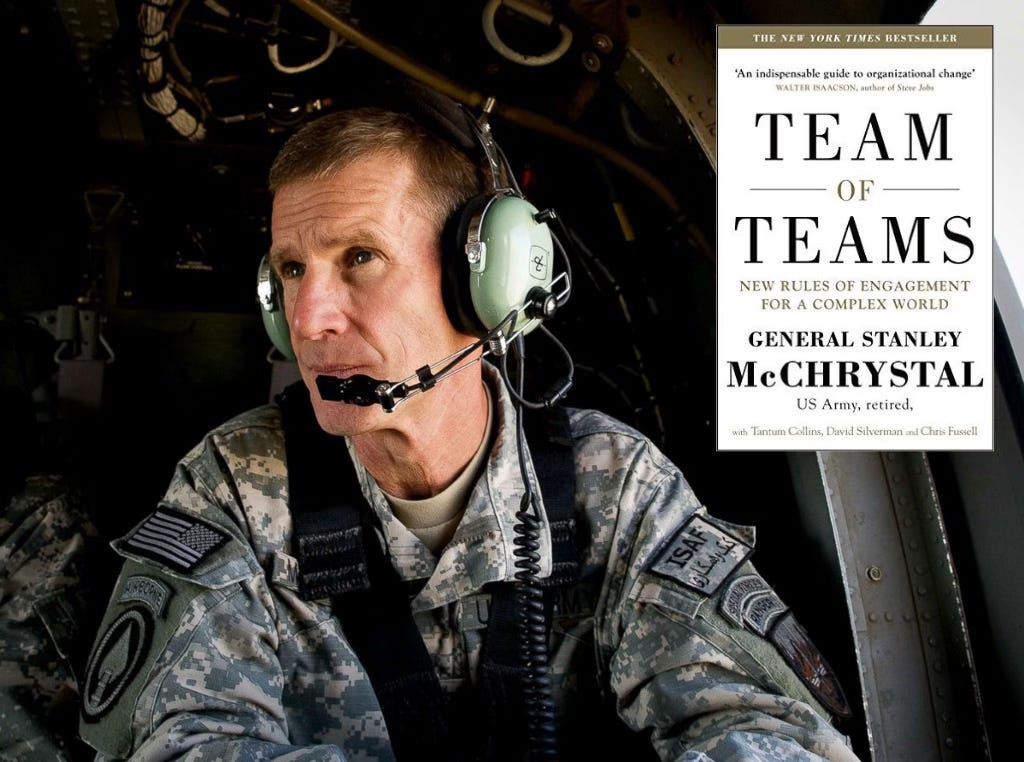
General Stanley McChrystal
General McChrystal spent decades inside the Joint Special Operations Command and his “one thing” was the study of how small, elite teams execute under uncertainty. But that depth of understanding led him to an insight that had nothing to do with tactics: traditional military hierarchies were too slow for the fight against decentralized networks. What he built in response was the “team of teams” model, which replaced rigid command structures with a shared-consciousness network. This was not a military innovation, it was an organizational design insight. His deep immersion in how special operations teams actually work gave him the lens to see that the fundamental problem was not intelligence or firepower, but the architecture of information flow. He saw ten thousand things (organizational theory, network science, trust dynamics…) because he knew one deep enough.
Paul O’Neill
O’Neill became CEO of Alcoa in 1987, a global leader in the production of aluminum. On his first speaking to investors he didn’t talk about revenue, margins, or market share. Instead, he talked about workplace safety. Wall Street analysts were unimpressed to say the least, some even called their clients and recommended selling the stock immediately.
But O’Neill understood something all those analysis didn’t because he had studied organizational performance deeply enough to see that safety was not a peripheral metric, it was in fact a proxy for everything. He knew that a company that can drive workplace injuries to near zero has, by definition, is one that has built extraordinary communication systems, empowered frontline workers to stop production when something is wrong, created feedback loops that move faster than bureaucracy, and embedded accountability at every level. Safety was his one thing, and through that one thing, he transformed Alcoa’s entire culture, operational discipline, and financial performance. By the time he retired, Alcoa’s market capitalization had increased fivefold.

From one thing, ten thousand things.
The Uncomfortable Truth About Breadth
Breadth is not useless, but breadth without depth is decoration.
Breadth gives you vocabulary, not vision. It lets you talk about strategy, but not to realize when a strategy is about to fail, it helps you recite frameworks but cannot make you capable of reading a room.
The leaders I have seen operate at the highest levels share something in common: they all went unreasonably deep in at least one domain before they went wide, and that depth became the root system from which everything else grew. It gave them what Musashi called the ability to “see the Way in everything,” an almost intuitive grasp of how systems work, how people move, and where the hidden leverage points are in any situation.
More often than not, the real question is not, “How many things do I need to learn?”, but “Have I gone deep enough in one thing to see the ten thousand things it reveals?”
The Invitation
What is your one thing?
Not the thing on your business card, but the thing you have studied so deeply that it changed how you see everything else. The domain where you don’t need to perform, because it’s the one that makes you perceive the whole world through it.
The secret Musashi carved into history is that the leader who sees ten thousand things is not the one who studied ten thousand things; it’s the one who refused to stop digging until the one thing revealed its deepest truth. Musashi says when you reach that depth, “there will not be one thing you cannot see.”
P.S. Before I go, here you have “The Treat,” where I share some of the music that kept me company while writing … Enjoy as you bid farewell to this post
“Lead yourself, Learn to live. Lead others, Learn to Build.”
If you enjoyed reading this post consider subscribing to the newsletter for free, joining the community and sharing your thoughts